
In the mid-1980s, there were an estimated 3.5 million cases of Guinea worm, spread over 21 countries in Africa and Asia. The disease is caused by drinking stagnant water that contains tiny water fleas that carry Guinea worm larvae. When ingested the larvae mature into thin, spaghetti-like worms that can grow up to three feet in length. A year after ingesting, the worm resurfaces — usually in the lower leg — and creates a very painful blister. Often, the victims try to relieve this pain by submerging their leg in water — which is exactly the wrong thing to do. Contact with the water causes the worm to burst, releasing millions of larvae back into the water, and the cycle continues.
In 1986, the scale of the problem got the attention of the Carter Center — launched by Jimmy and Rosalynn Carter four years earlier — who took the lead in putting together a global collaborative effort to target the disease. The US Centers for Disease Control, the World Health Organization, and UNICEF, along with a number of industrial partners, all joined in the effort, creating the Guinea worm eradication program. By the late 1980s, country-specific programs were launched in Pakistan, Ghana, and Nigeria, and others followed soon thereafter.
Given the source of the problem — contaminated drinking water — the solution required to address it involved a combination of behavioral changes among the population, field observations on usage, and an engineering response to those observations that would screen out the contaminants. The industrial partners developed and donated massive quantities of nylon filter cloth with a pore size of 100 microns — fine enough to trap the water fleas, but large enough to allow the water to pass through. In the field, the Carter Center staff noticed that Tuareg nomads from Mali were packing this filter material in multiple layers in reeds so that they could drink the filtered water directly from any water source — allowing them to walk and drink safely without the need for a base camp. From these observations, the Carter Center approached the privately-held company Vestergaard, who created a pipe filter with a durable plastic body and a stainless steel mesh — increasing the lifespan considerably. Over 40 million of these pipe filters have been distributed since the 1990s.
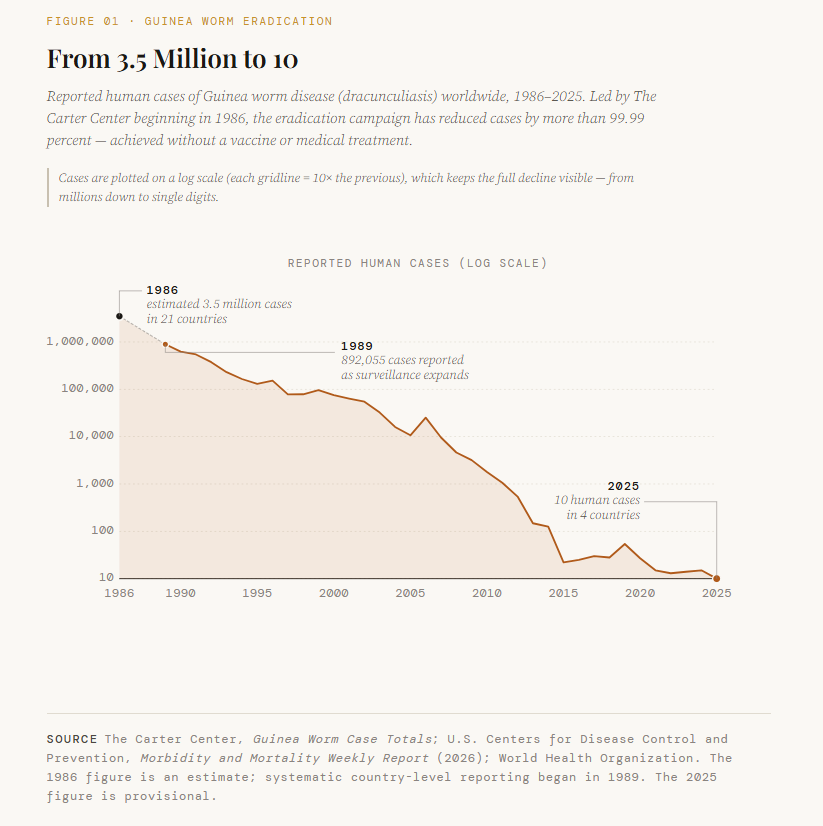
The results from this program have been stunning. By 2025, the number of Guinea worm cases had dropped by 99.99% — to an estimated ten documented cases.1 When the disease has been completely eradicated, it will be the first human disease to be eliminated through education and behavioral changes. In 1988, after Jimmy Carter had visited a village in Ghana, where 350 people had worms emerging from their skin, his commitment to eliminating this disease became his defining mission. He often said that he hoped to outlive the last Guinea worm. He passed away in December 2024, and in that year there were 15 reported cases. By the end of the following year, there were ten — on its way to zero.
References:
1 https://www.cartercenter.org/news/guinea-worm-announcement/