Brief: The Technology Reshaping the Business of Diamonds
A chemistry breakthrough, a crumbling cartel, and an unforeseen human rights victory

In the last decade, the cost of a one-carat mid-grade synthetic diamond has dropped by 82%, falling to under $900 in 2024.1 This has led to an explosion in usage for a growing range of industrial applications. Synthetic diamonds have exceptional thermal conductivity — ideal for semiconductor heat management — and are also used in various precision manufacturing applications that underlie modern electronics. The cost reduction is the result of a technological innovation that began 40 years ago, further refined in the 2000s, called Chemical Vapor Deposition (CVD). This technology involves growing diamonds atom by atom from a gas, a fundamental shift in both efficiency and cost from the high-temperature, high-pressure process used when synthetic diamonds were first developed in the 1950s.
An unintended consequence of this new technology is a collapse in demand for mined diamonds — those used principally in high-end jewelry — which were mined, primarily in parts of Africa, often using child laborers who were forced to endure exposure to hazardous substances and extreme physical demands. Throughout the 20th century, taking these diamonds from the mine to the market was monopolized by De Beers Consolidated Mines, who controlled 80-90% of the rough diamond distribution. De Beers proved to be very effective at controlling the gem-quality diamond market by increasing or decreasing the supply of diamonds to keep prices high. The monopolistic practices led to an antitrust suit by the US government, which resulted in a $295 million settlement in 2012.
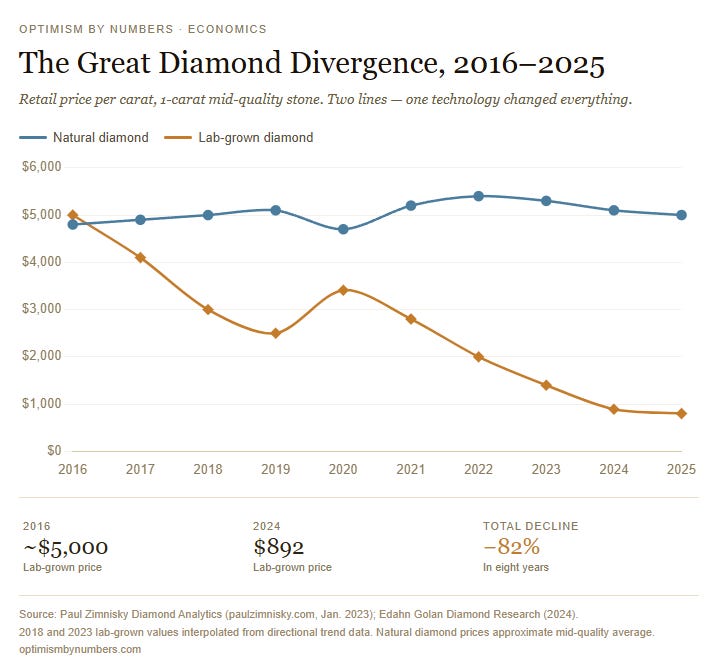
By the 2010s, CVD was producing colorless, high-clarity stones that were indistinguishable from the finest mined diamonds — and the impact on De Beers has been swift and devastating. The enterprise value of De Beers in 2012 was $12.75 billion — the year it was acquired by Anglo American, a UK mining conglomerate. The company has taken writedowns of $6.8 billion over the past three years, and today, its value has declined to just $2.3 billion, a more than 80% drop from 2012.
Technological progress rarely stays within its intended boundaries — and in this case the unforeseen consequences have been profound. A process developed to support innovation in industrial manufacturing ended up undermining a monopoly — and in doing so, it began removing the economic foundation that made child labor in diamond mines viable in the first place.
References:
1 https://www.paulzimnisky.com/Lab-Diamond-Sales-Grow-as-Prices-Fall