Building a Biological Clock
Why measuring age may be the key to extending healthy life

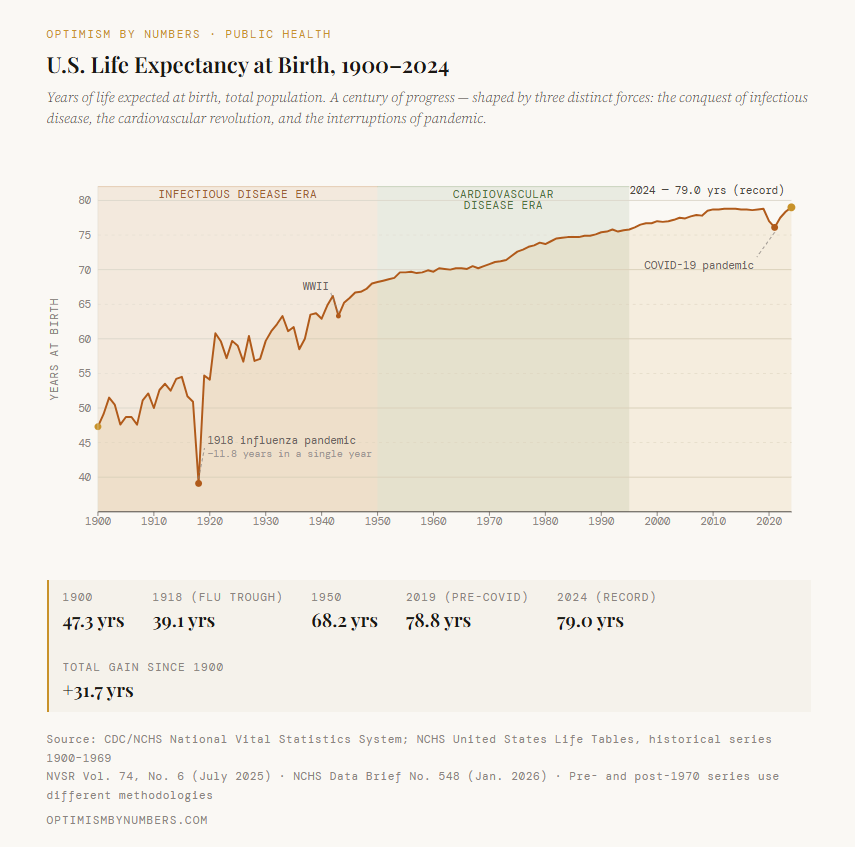
For most of human history, how long people lived was largely a matter of chance. In 1900, life expectancy in the US was 47 years — and there was a 20% chance that a newborn wouldn’t live beyond their fifth birthday. The leading causes of death were pneumonia, tuberculosis, diarrheal diseases, and diphtheria — all infectious diseases. Together these accounted for one-third of all deaths — and children under five accounted for 40% of those deaths. By 1950, US deaths from infectious diseases had declined by 90% — so the public health and medical breakthroughs of the first half of the 20th century fundamentally changed the odds of reaching adulthood.1
Taming infectious diseases in the US was the first of two waves of innovations that drove significant increases in lifespan across the 20th century. The early gains were primarily tied to public health improvements, such as chlorination, clean water, and enhanced sanitation. Chlorination alone accounted for almost half the total mortality reduction between 1900 and 1936.2 These were civic and engineering achievements as much as medical ones. Vaccines, antibiotics, and other medical breakthroughs amplified and extended these benefits.
The second innovation wave addressed cardiovascular disease, which had risen steadily through the first half of the 20th century. Peaking at 307 deaths per 100,000 in 1950, mortality declined by 56% by 1996, the result of improvements in emergency care, medical interventions, and pharmaceuticals, as well as population-level behavioral and lifestyle changes such as the reduction in smoking. These two waves combined with other medical and public health advancements led to a 61% increase in lifespan by the end of the century.
The picture has gotten more complicated since 2000. While progress continues to be made in both cardiovascular and infectious diseases, the pace of the improvement has slowed. The annual rate of decline in age-adjusted deaths for heart disease was 3.7% per year in the decade of the 2000s, but had fallen to 0.7% in the decade after.3 Excluding the COVID pandemic, which was an acute and anomalous event, deaths from infectious diseases remain at historically low levels and represent a small fraction of the mortality from the early 20th century. However, other factors have entered the picture that have exerted downward pressure on US lifespan — notably deaths from the opioid crisis, which disproportionately impacted young and middle-aged Americans, and the obesity epidemic. Nonetheless, life expectancy did reach a record in 2024, at 79 years.
This slowdown in lifespan progress points to a deeper issue — advancements in successfully treating specific diseases and understanding how the aging process works are two different things. Until recently, the only way to measure a person’s age was chronologically — based on the number of years since birth. But two people born on the same day can be biologically decades apart in their risk of disease and premature death. It turns out the calendar is a poor guide to what is actually happening inside the body — and the mechanisms that cause aging are still not well understood. And understanding these mechanisms is the essential first step toward extending what scientists call healthspan — the number of years spent in good health rather than simply alive. You cannot extend something you cannot measure. So while scientists have made remarkable progress in understanding specific aspects of the aging process, the overall picture remains elusive.
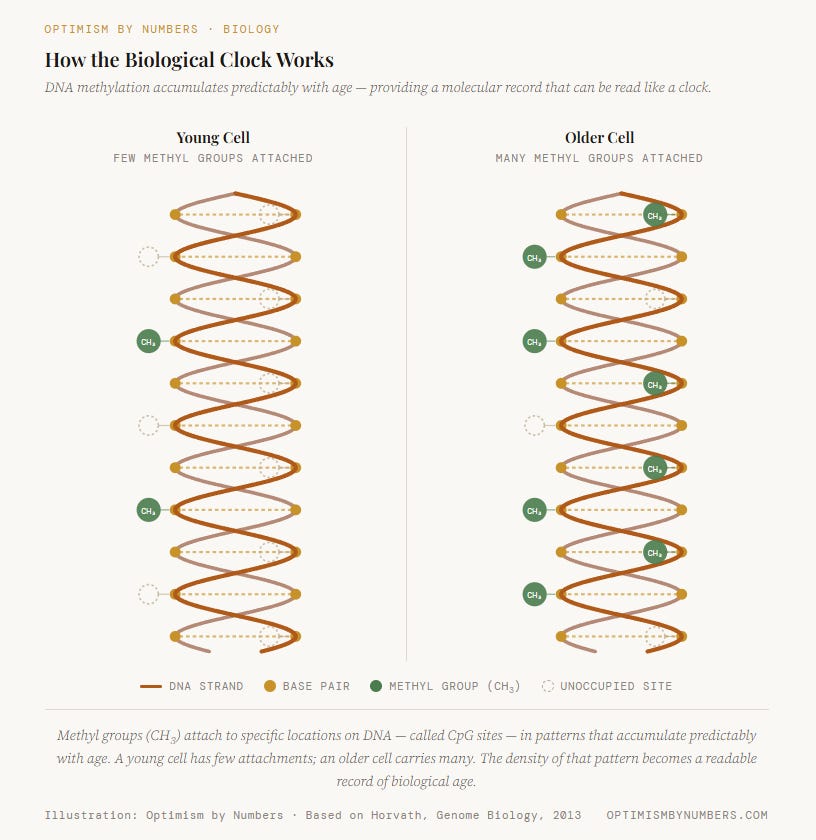
One piece of the puzzle had been known for decades — the chemistry of DNA methylation. The cells in your body carry a chemical record of their history in the form of small molecular tags — called methyl groups — which accumulate on your DNA in predictable ways and are consistent from person to person. These patterns change with age in ways that are measurable and consistent enough to provide an estimate of the age of a cell. The methyl groups don’t affect the DNA itself — but they do impact which genes are switched on or off. These insights had been well understood by scientists since the 1960s. What was missing was the computational power to make use of them.
The earliest practitioner to bridge these technologies came from an unexpected direction — with PhDs in both mathematics and biostatistics. Steve Horvath, a professor of Human Genetics and Biostatistics at UCLA, is credited with creating the first clock based on DNA methylation. In a landmark paper published in 2013, Horvath analyzed DNA methylation data from a wide range of tissue types, taken from publicly available data, to show a remarkably high correlation between DNA methylation age and chronological age. Importantly, in this same study, Horvath showed DNA methylation age reads close to zero for embryonic stem cells, suggesting that the biological clock starts at close to zero at the beginning of cellular life.4
While Horvath’s clock (a first generation clock) could very precisely determine biological age — and correlate this with chronological age — its use in predicting health outcomes was limited. Subsequent generations of biological clocks have been developed that have combined DNA methylation data with other biomarkers to provide a more complete picture of disease vulnerabilities. In a 2023 paper published in Proceedings of the National Academy of Sciences (PNAS), the second and third generation biological clocks were significant predictors of health outcomes for cognitive decline, functional limitations, chronic conditions, and 4-year mortality.5
Even as these clocks have continued to advance, completely different approaches are emerging that are providing new insights on aging. Proteomic aging clocks measure thousands of proteins circulating in the blood rather than DNA methylation. Researchers have now built organ-specific proteomic aging clocks that can track aging of different organs. Importantly, they have found that organs in an individual may not all age at the same rate — meaning your brain and your heart may have quite different biological timelines — and this is not something that DNA methylation, on its own, can detect.
While biological clocks may ultimately replace the calendar as the basis for measuring age, it is still early days. There remains a significant difference between measuring biological age and developing interventions to counteract the aging process — in other words, extending healthspan. But the scale of the effort underway suggests the scientific community is fully engaged — the number of peer-reviewed publications on aging research has increased by 3500% since 2000.6 And the investor community has weighed in as well — according to Longevity.Technology’s 2024 annual report, global investment in longevity research reached $8.5 billion in 2024, more than double the previous year.7 Understanding the aging process is the first step toward slowing it —and that process is underway.
References:
1 https://www.cdc.gov/mmwr/preview/mmwrhtml/mm4829a1.htm
2 https://pubmed.ncbi.nlm.nih.gov/15782893/
3 https://www.cdc.gov/nchs/products/databriefs/db425.htm
4 https://pubmed.ncbi.nlm.nih.gov/24138928/
5 https://www.pnas.org/doi/10.1073/pnas.2215840120
These Optimism by Rick S are so thoughtful and smart. Tell us more please.