Reading the Plant
Centuries of working blind, and the science that changed it

A plant is anchored to a single location where its seed happens to land — be it by way of wind, a planter, a bird, a flood, or some other factor outside its control. From its fixed position, survival depends upon its ability to adapt to a drought when the rains fail, defend against an incapacitating fungus, or withstand any other location-specific threat that comes its way.
With animals, a specific trait lives within the individual animal — a fast horse is observably fast, and can be bred to produce other fast horses, and this has been understood for millennia. Plants are different. The success of a particular breeding plan for wheat, for example, is only apparent at harvest time, and the impact is spread across the entire harvest. And even then, the results can be confounded — the arrival of a flood or drought at the wrong time can make the best breeding plan meaningless. For most of human history, farmers couldn’t see what was happening inside the plant — and the harvests showed it. That began to meaningfully change by the mid-20th century, and an unusual partnership between two scientists on different continents played a significant role in this transformation.
Norman Borlaug, an American, was born in 1914 on a farm near Cresco, Iowa. While the Great Depression is often dated to the stock market crash of 1929, it actually began much earlier for the Midwest farmers. Through the 1920s — while much of urban America was experiencing the Roaring Twenties — Borlaug witnessed first-hand neighbors losing farmland they had worked for generations. The Dust Bowl of the 1930s added to this tragedy. This front-row seat to the devastation had a significant influence on his decision to study plant biology, and he earned a PhD in 1942 from the University of Minnesota in plant pathology.
His collaborator was M.S. Swaminathan, born in 1925 in Tamil Nadu in Southern India. His father was a physician, and Swaminathan had secured a place in medical school when a 1943 famine hit Bengal. The famine killed over two million people, many from starvation. Within a few years, Swaminathan had decided to abandon medical school in favor of plant genetics, which he studied at the Indian Agricultural Research Institute (IARI).
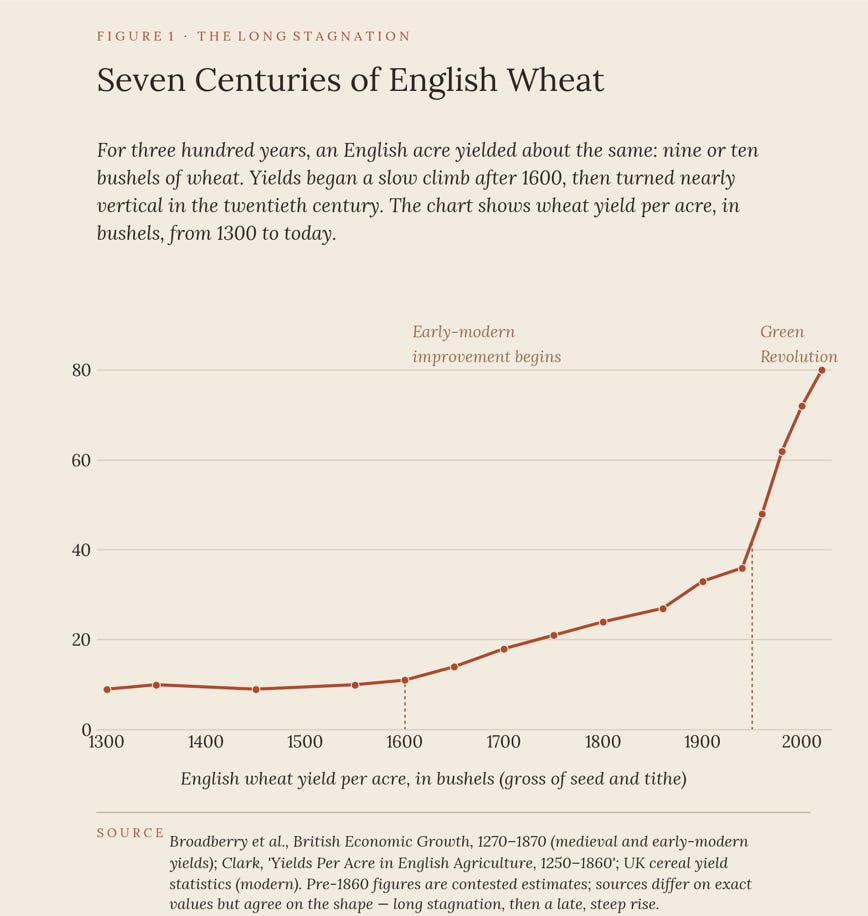
The two met in July 1953 at the University of Wisconsin-Madison, where Swaminathan, then a post-doctoral fellow, heard a Borlaug lecture on controlling wheat rust. Borlaug, working in Mexico for a Rockefeller Foundation program to improve wheat yields, had spent the past decade crossing thousands of wheat varieties to build disease resistance. Combining semi-dwarf genes from Japanese wheat with his rust-resistant lines, he created a short, stiff-strawed variety that could carry much heavier grain heads without collapsing. This mattered because the variety converted the available water, sunlight, and fertilizer into more grain rather than more stalk. The Borlaug research program impressed Swaminathan and the two began a correspondence that continued after Swaminathan returned to India. In 1963, recognizing the success of Borlaug’s program — Mexico had become wheat self-sufficient by 1956 — and that the Mexican wheat varieties could be adapted to Indian conditions, Swaminathan invited Borlaug to India to help address what looked to be a threat of mass famine in the subcontinent. Separately, the Rockefeller Foundation, the sponsor of Borlaug’s research, arranged for him to visit Pakistan as well, which faced a similar threat. In 1965, 450 tons of two of Borlaug’s wheat varieties were planted in India and Pakistan. The spring 1966 wheat harvest was the largest South Asia had ever seen — and this harvest came out of serious drought conditions in 1965.1 By 1970, wheat production in India had reached about 20 million tons, 60% higher than the 1965 total. Pakistan saw a similar increase, and reached wheat self-sufficiency by 1968. Borlaug and Swaminathan — who remained close throughout their entire lives — helped to usher in the Green Revolution, a global effort that combined new varieties, synthetic fertilizers, and expanded irrigation to increase food production. In 1970, Borlaug was awarded the Nobel Peace Prize for “having given a well-founded hope — the green revolution.” At the time, some prominent voices were predicting mass famine in the subcontinent. Stanford biologist Paul Ehrlich’s The Population Bomb, published in 1968, predicted hundreds of millions of deaths in the 1970s, with India singled out as a country that would be unable to feed its growing population. Between 1960 and 2000, the world population doubled. Wheat yields in the developing world tripled.2
In the latter decades of his life, Swaminathan became concerned with the second-order effects of the increase in farm productivity he helped to create: groundwater depletion, excess fertilizer use, loss of genetic diversity, and a series of downstream environmental effects. This led to his coining of the phrase “Evergreen Revolution.”3 He did not view this as a repudiation of the Green Revolution — rather, he saw it as the continuation of the effort in a more sustainable way. And while he viewed the arrival of new technologies as possible solutions to some of these concerns, he believed the first wave — genetically modified crops — was too focused on extending intensive agriculture at the expense of sustainability.
Genetically modified crops, or GMOs, arrived on the scene in the 1990s, the result of advances in recombinant DNA technology — a technique that allows a gene from one organism to be transferred to another. This was a sharp departure from Borlaug’s work — where plants from the same species are crossed and natural reproduction causes the genes to shuffle. GMOs involve the transfer of specific genes across species — to introduce a particular trait. Early GMO crops were largely focused on increasing the productivity of farmers. And while genetically modified cotton and corn led to meaningfully less insecticide use, the overall environmental impact was mixed. Even so, by 1999, over 100 million acres worldwide were planted with GMO crops. A different technology would be required to address the sustainability challenges raised by Swaminathan, and that technology was CRISPR.
CRISPR was built on fundamental research through the 1990s and early 2000s by Francisco Mojica in Spain. In 2012, research by Jennifer Doudna and Emmanuelle Charpentier showed that the CRISPR system could be reprogrammed to cut any DNA sequence at a precise location — which for plants means specific genes could be manipulated to improve traits like drought tolerance, nutritional value, and disease resistance. These were exactly the kinds of traits envisioned in Swaminathan’s Evergreen Revolution.
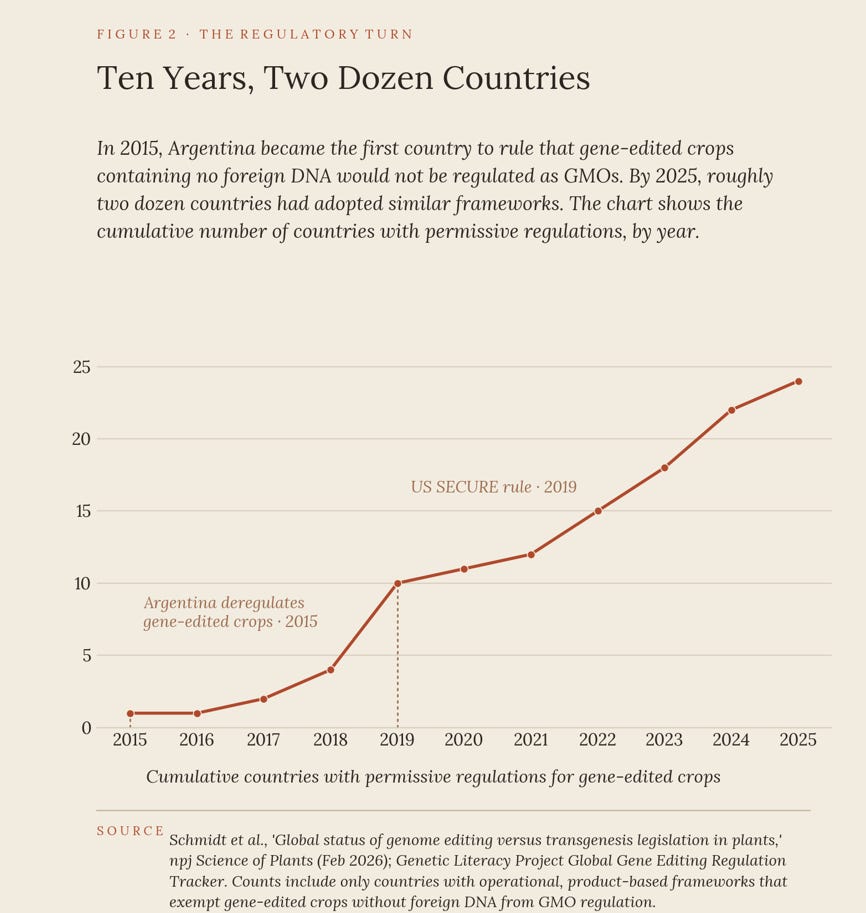
One major difference between CRISPR and earlier GMO foods has been the willingness by governments around the world to adopt the technology. Because the vast majority of CRISPR edits are to the plant’s own, existing DNA — meaning there is no foreign DNA introduced — there are now 24 countries that regulate CRISPR-edited plants differently than transgenic GMO crops. In fact, the US adopted the SECURE rule in 2019 that does just that. Meanwhile, newer technologies are emerging that build on the CRISPR successes. One such technology is being developed by a California-based start-up, Ohalo Genetics.
Throughout their evolutionary history, plants have successfully adapted to polyploidy — the state that results when a plant’s genome is doubled, leaving it with more than two complete sets of chromosomes in each cell. Many important crops consumed today are polyploid — coffee, bananas, strawberries, and oats are examples. These are the result of genome-doubling events from their evolutionary past. Polyploid plants often grow larger and more vigorously, in part because functional copies of genes from one parent can overcome damaged copies from the other. Ohalo is using engineered proteins to induce polyploidy, initially into potatoes, with plans to expand to other species in the future. The results from their trials are encouraging — yields are 50%-100% higher than conventional breeding produces. Importantly, this represents a new category of intervention — and there are no foreign genes being introduced into the plants. It is simply that all of the genes available from both parents are inherited — and the plant benefits from the wider range of working genes that combination provides. And because no foreign DNA is introduced into the process, regulatory acceptance should resemble that of the pathway for CRISPR-edited crops.
For many thousands of years, farmers worked mostly blind to the inner workings of the crops they grew. Borlaug’s generation took selective breeding as far as it could go. What has changed since is this: plant genomes can now be read and edited. The plant is still anchored to the spot where the seed landed. But we can now see what is inside it.
References:
1 https://link.springer.com/article/10.1007/s40003-013-0069-3
2 https://www.fao.org/4/Y5160E/y5160e08.htm
3 https://www.croptrust.org/news-events/news/obituary-ms-swaminathan-1925-2023/
Your articles are so well written and make science accessible to all. Leaves me optimistic about the promises of science to solve problems of our ailing planet.