The Disappearing Boundary
Three scientists, a Tokyo reception, and the discovery that changed the screen in your pocket

In 1975, during a six-month sabbatical as a visiting professor in Japan, University of Pennsylvania professor Alan MacDiarmid was invited to give a lecture at the Tokyo Institute of Technology on his research in metallic polymers, a new field of study in the 1970s. The name of the field is somewhat oxymoronic — polymers by their nature do not contain metals. Rather, they were considered insulators — think plastic coatings on electrical cords that plug into a socket. During the post-lecture reception MacDiarmid met Hideki Shirakawa, a junior researcher at the Institute who was also pursuing research in this field. Their discussion was so fruitful that, on the spot, MacDiarmid invited Shirakawa to spend a year at Penn, where he arrived the following year as a post-doctoral fellow.1 In 1977, the pair — joined by Alan Heeger, a Penn physicist — published a paper that paved the way for the recent explosion in modern TV and smartphone screen development, and earned the trio a shared Nobel Prize in Chemistry.
MacDiarmid’s research was focused on sulfur-nitride polymers — long chains of sulfur and nitrogen atoms that produced beautiful crystals with a golden metallic sheen. In the early 1970s, scientists had discovered that this material actually conducted electricity like a metal — not at the same level as a metal, but a conductor nonetheless. MacDiarmid had found that by treating this polymer with another substance — in a process referred to as doping — the conductivity increased ten-fold. He was now exploring ways to build on his progress, while seeking to understand more deeply what made these polymers conduct electricity in the first place.
Meanwhile, Shirakawa was working with a different non-conducting polymer. At the reception, what Shirakawa shared with MacDiarmid was the fact that his polymer formed silvery metallic films that nonetheless did not conduct electricity. Shirakawa had discovered this by accident years earlier. A visiting scientist working in his lab mistakenly added 1000 times more catalyst to a polymer reaction they were running than was called for — and the silvery film appeared in the reactor. This is what intrigued MacDiarmid the most — a metallic looking polymer that behaved differently from his. While working together at Penn, the three of them — including Heeger — found that by treating Shirakawa’s polymer with the right doping material — in this case iodine, similar to what MacDiarmid used in his sulfur-nitride trials — the conductivity of the polymer increased by a factor of 10 million, approaching that of a metal. Essentially, the boundary between insulators and conductors was being dissolved.
Most smartphone screens — and a growing number of premium flat-screen TVs — operate using organic light-emitting diode (OLED) technology, a direct beneficiary of the discoveries by the Penn team. However, OLED requires more than just a polymer that can conduct electricity. It also requires another technology that can turn an electrical signal into light. The early breakthrough for that came in the late 1980s. Ching Tang and Steven Van Slyke, two chemists working for Eastman Kodak in Rochester, New York, were working with a small organic molecule that, when sandwiched between two electrodes, would emit a green light when voltage was applied — the first recognizable organic light emitting diode. Their paper was published in Applied Physics Letters in September 1987.2 This established the basic architecture that underpins the OLED screens in use today.
It would take another decade before these new technologies could be combined in a way that would allow prototypes of OLED to be developed. One of the key problems was the need for molecules that would emit the required red and blue light to complement the green light from the Tang/Van Slyke discovery. These three lights — red, green, and blue — can be combined to emit the full spectrum of colors visible on a screen. It turns out that identifying molecules that would emit red light was fairly straightforward to engineer. However, engineering molecules that emit blue light is a different matter entirely. The nature of blue light — short wavelength and high-energy relative to green and red light — places the molecule under electronic stress each time it emits light. Thus, engineering the right molecule that can withstand these stresses, while solved to some degree with today’s technology, continues to be a focus of research by manufacturers even today.
The 2000 Nobel Prize in Chemistry was awarded to MacDiarmid, Shirakawa, and Heeger for “the discovery and development of conductive polymers.” The wording from the Nobel committee was very precise, recognizing not just the 1977 paper but also the more than two decades of development that followed. The Prize arrived just as the technology had been developed enough that commercial applications were beginning to appear. The first application was actually introduced by Pioneer, in 1997, in the form of a small green OLED display in a car stereo — using the technology developed by Tang and Van Slyke. Kodak followed two years later with an OLED viewfinder in their digital camera. However, these early adoptions were the exception rather than the rule — a number of obstacles had to be overcome before OLED found its footing.
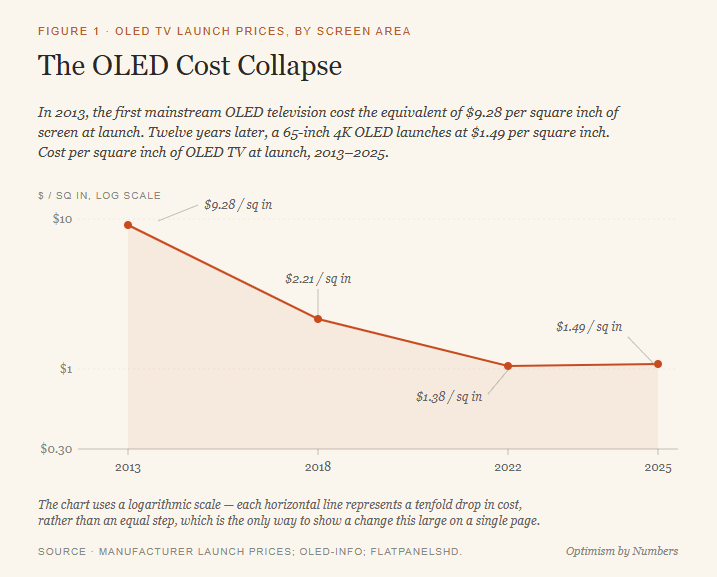
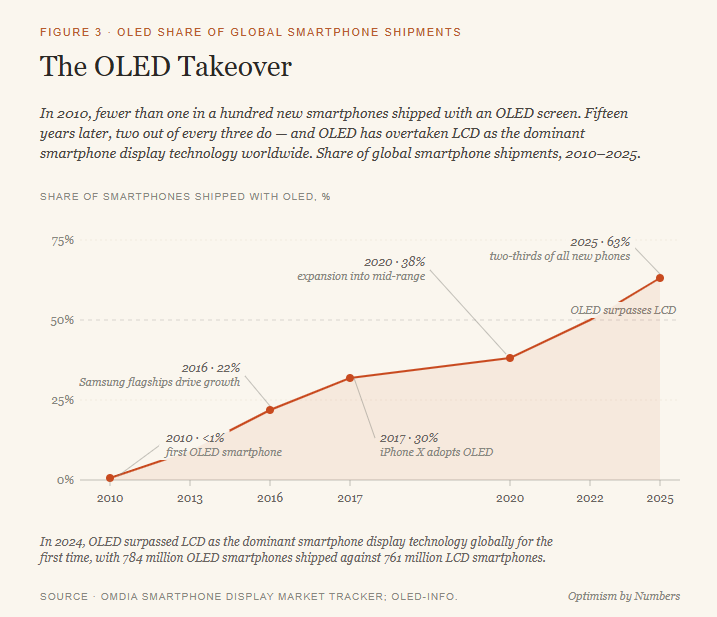
The first commercially available OLED flatscreen TVs didn’t arrive until 2008. The blue light problem continued to hobble adoption through the 2000s and into the 2010s. Liquid crystal display (LCD), the competing technology, continued to advance in quality, and was cheaper to manufacture than OLED. This would change in the late 2010s and early 2020s, as the quality differential began to favor OLED screens — most notably in the premium end of the market. Smartphone screens have followed a similar trajectory. Samsung introduced OLED screens in 2009-2010, and Apple followed suit with their iPhone in 2017. By 2024, OLED had become the dominant display technology in the smartphone market.
Perhaps most significantly, the inherent advantages of conducting polymers — flexibility, the potential for transparency, the printability, among others — are creating a plethora of new products and applications that were previously unimaginable. Foldable smartphones and wearable medical sensors both require the flexibility that only this class of materials provides. Transparent solar cells — windows that generate electricity while letting light through — were generally impossible before conductive polymers. Finally, printed electronics, where conducting polymers can actually be printed on traditional substrates like paper, plastics, and textiles — has created an entirely new category of low-cost tracking devices that help move billions of products through global supply chains every year. Each of these is a new product category that did not exist before the development of conducting polymers.
Nearly fifty years after the landmark paper by MacDiarmid, Shirakawa, and Heeger, the boundaries between conductors and insulators continue to disappear. The path has been anything but a smooth line — bumpy would be a better descriptor. But the trajectory over the past decade has been remarkable — certainly beyond what the trio could have imagined in 1977 — and it looks likely to continue.
References: